Call Us
86-755-82924037
Call Us
86-755-82924037

Selecting the right laser lens depends on the laser wavelength, beam characteristics, optical performance requirements, and operating environment. The most commonly used laser lens types include focusing lenses, collimating lenses, beam expanders, protective windows, and specialty laser optical components designed for specific applications.
For industrial laser processing, medical systems, scientific instruments, and optical communication equipment, choosing the correct laser optical lens is essential for achieving accurate beam delivery, stable energy distribution, and long service life.
Different applications require different optical functions. The major laser lens types used in industrial systems include:
Focusing lenses concentrate a laser beam into a small focal spot to achieve high energy density. They are commonly used in:
Laser cutting
Laser welding
Laser engraving
Laser marking
Material processing
A high-quality focusing laser lens must provide excellent surface accuracy, low aberration, and strong resistance to laser-induced damage.
Collimating lenses convert divergent laser output into a nearly parallel beam. They are widely used in:
Laser diode modules
Fiber laser systems
Measurement equipment
Optical sensing devices
The performance of a collimating lens directly affects beam divergence and transmission efficiency.
Beam expanders increase beam diameter while maintaining beam quality. They are commonly used before focusing optics to improve:
Focus resolution
Depth of focus
Long-distance beam transmission
Protective optics, such as cover lenses and windows, protect expensive internal components from:
Dust contamination
Smoke and debris
Laser processing particles
They are especially important in high-power industrial laser systems.
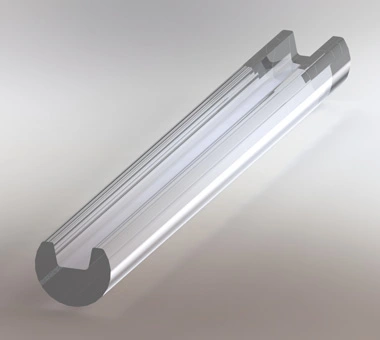
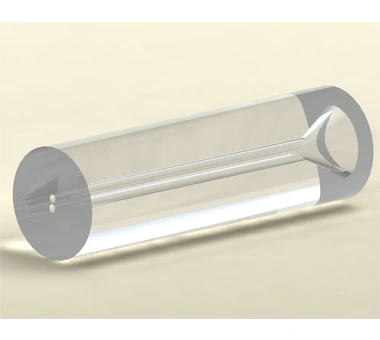
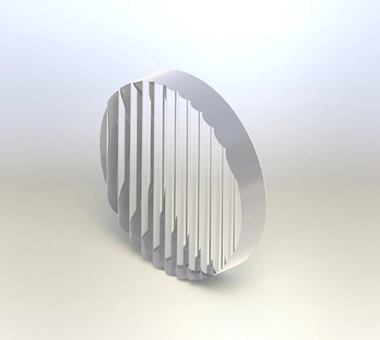
Custom optical components may include:
Cylindrical lenses
Aspherical lenses
Achromatic lenses
Diffractive optical elements
These solutions are often developed for applications requiring precise beam shaping or wavelength control.
Professional laser lenses suppliers usually provide customized solutions based on the complete optical system rather than offering only standard components.
The main difference is their optical function.
A focusing lens converts a parallel laser beam into a concentrated focal point. It is selected based on:
Required spot size
Focal length
Working distance
Laser power density
A collimating lens performs the opposite function by reducing beam divergence and creating a parallel output.
For example:
A laser cutting head requires a precision focusing lens.
A laser diode module often requires a collimating lens.
A fiber laser system may use both collimation and focusing optics.
Poor optical selection can cause:
Reduced energy efficiency
Larger focal spots
Uneven power distribution
Thermal damage
Shorter optical lifetime
A properly designed laser optical lens ensures that the beam reaches the target with maximum accuracy and stability.
Laser lens material selection depends mainly on wavelength, power density, and environmental requirements.
Common optical materials include:
Fused silica is widely used for UV and visible laser applications because of:
High transmission
Low thermal expansion
Excellent laser damage resistance
Optical glass materials are commonly used for visible and near-infrared laser systems where cost efficiency and optical performance must be balanced.
Calcium fluoride provides excellent transmission from ultraviolet to infrared wavelengths and is often used in specialized laser systems.
ZnSe is commonly selected for infrared laser applications, especially CO₂ laser systems operating at 10.6 μm.
High-power lasers place greater demands on optical components.
Important considerations include:
Laser damage threshold
Absorption characteristics
Thermal stability
Coating durability
Surface quality
A lens suitable for a low-power alignment laser may fail quickly in a high-power cutting system due to thermal stress or coating damage.
Laser coatings improve transmission efficiency and protect optical surfaces.
Common coating requirements include:
Anti-reflection coatings
High-power laser coatings
Broadband coatings
Wavelength-specific coatings
Without proper coatings, reflection losses can reduce system efficiency and increase unwanted heat buildup.
Surface quality directly impacts beam performance.
Important specifications include:
Surface flatness
Surface roughness
Centration accuracy
Wavefront distortion
Clear aperture
High-precision laser systems require tighter optical tolerances because even small imperfections can affect:
Beam shape
Focal accuracy
Processing consistency
For demanding applications, experienced laser lenses suppliers typically provide detailed inspection reports to verify optical performance.
To obtain an accurate quotation and suitable optical design, customers should provide:
Laser wavelength
Laser power or energy density
Beam diameter and divergence
Required focal length
Working distance
Lens material requirements
Coating specifications
Dimensional tolerances
Production quantity
These parameters allow optical engineers to determine the most suitable design and manufacturing process.
A qualified supplier should have experience with:
Precision optical manufacturing
Laser coating technology
Optical testing capabilities
Custom lens design
Quality control procedures
The right supplier should not only manufacture the lens but also provide engineering support to optimize the optical solution for the final application.
At Lens66, customized optical solutions are developed based on application requirements, helping customers select suitable materials, designs, and manufacturing methods for laser systems.
Choosing the correct laser lens requires a complete understanding of beam characteristics, wavelength, power level, and application requirements. Different laser lens types serve different functions, from beam focusing and collimation to protection and beam shaping.
High-quality laser optical lenses improve system efficiency, accuracy, and reliability. Whether for industrial processing, scientific research, or commercial equipment, working with experienced laser lenses suppliers helps ensure the optical design meets both performance and production requirements.
The most common types include focusing lenses, collimating lenses, beam expanders, and protective optics.
Choose based on wavelength, laser power, focal requirements, material, coating, and application environment.
The best material depends on wavelength and power level. Fused silica, optical glass, ZnSe, and CaF₂ are commonly used.
Coatings improve transmission efficiency and protect lenses from laser damage.
Yes. Custom laser lenses can be designed according to beam parameters, dimensions, and application requirements.
 English
 日本語
日本語 한국어
한국어 français
 Deutsch
 Español
 italiano
 português
 العربية
 tiếng việt
 ไทย
ไทย