Call Us
86-755-82924037
Call Us
86-755-82924037

In infrared optical systems, material selection directly affects imaging quality, signal transmission, system size, and long-term reliability. Among many infrared optical materials, germanium infrared lenses are widely used in thermal imaging cameras, IR sensors, night vision devices, industrial inspection systems, and scientific instruments.
Germanium is valued because it offers strong infrared transmission, a high refractive index, and good compatibility with anti-reflection coatings. These characteristics make it suitable for compact optical designs where accurate focusing and stable infrared performance are required. However, choosing the right germanium lens is not only about selecting a diameter or focal length. Engineers also need to consider wavelength range, coating design, surface quality, environmental conditions, and manufacturing tolerance.
This guide explains how germanium infrared lenses work, where they are used, and what buyers should consider when sourcing custom germanium lenses for precision infrared systems.
Germanium infrared lenses are optical lenses made from germanium, a material commonly used for transmitting and focusing infrared radiation. Unlike standard optical glass, which is mainly used in visible-light systems, germanium is suitable for infrared wavelengths, especially in thermal imaging and long-wave infrared applications.
Germanium is often selected for infrared systems because of its high refractive index. Edmund Optics lists germanium’s refractive index at about 4.003, which allows strong optical power and compact lens designs, but also causes significant reflection loss without anti-reflection coatings.
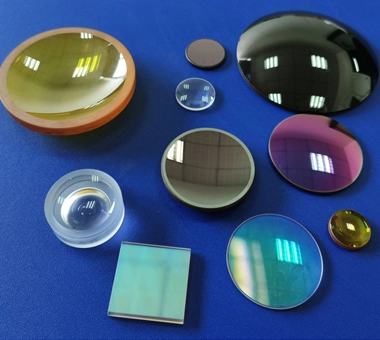
In practical optical design, germanium lenses may be produced in different forms, including:
Plano-convex lenses
Plano-concave lenses
Meniscus lenses
Aspheric lenses
Custom spherical lenses
Custom IR lens assemblies
Infrared windows and protective optics
For B2B applications, germanium lenses are often customized according to the optical system’s wavelength range, field of view, focal length, detector size, operating temperature, and mechanical assembly requirements.
Germanium is not chosen randomly. It has several optical and physical properties that make it especially useful for infrared applications.
One of its most important advantages is infrared transmission. Crystran notes that germanium covers the 8–14 μm thermal band and is widely used in lens systems for thermal imaging. This wavelength range is important because many thermal imaging systems operate in the long-wave infrared region.
Germanium also has a high refractive index, which means it can bend infrared light strongly. This allows designers to achieve focusing performance with fewer or thinner optical elements in some systems. Edmund Optics also explains that higher-index IR materials can help reduce the number of lens elements needed in an optical system.
Key advantages of germanium include:
Strong performance in thermal infrared systems
High refractive index for compact lens design
Low chromatic dispersion in the infrared range
Good compatibility with AR and DLC coatings
Suitable for thermal imaging and IR sensing
Good mechanical hardness compared with some other IR materials
However, germanium also has limitations. It is relatively dense, which matters in weight-sensitive systems. Edmund Optics notes that germanium has a density of 5.33 g/cm³ and that its transmission decreases as temperature increases, so it is generally recommended for use below 100°C.
For this reason, the final lens design should always match the application environment, rather than relying only on the material’s general advantages.
Because germanium infrared lenses transmit and focus infrared radiation effectively, they are used in many industrial, security, scientific, and commercial systems.
Common applications include:
Thermal imaging cameras
Infrared surveillance systems
Night vision equipment
Industrial temperature monitoring
Fire detection and safety systems
Automotive infrared sensing
Medical and scientific IR instruments
Gas detection systems
Laser and infrared measurement equipment
Defense and aerospace optical modules
In thermal imaging systems, germanium lenses help collect infrared radiation emitted by objects and focus it onto an infrared detector. This allows the system to create images based on temperature differences rather than visible light.
In industrial inspection, germanium infrared lenses may be used in cameras that monitor equipment temperature, detect overheating components, inspect electrical systems, or identify process abnormalities. In security and surveillance systems, they support imaging in low-light or no-light environments where visible cameras cannot perform effectively.
For OEMs and system integrators, the most important point is that different applications require different optical specifications. A lens used in a compact handheld thermal camera may have different requirements from one used in a fixed industrial monitoring system or a high-precision scientific instrument.
When selecting or customizing germanium infrared lenses, several specifications should be confirmed before production. These parameters directly affect optical performance, assembly compatibility, and system reliability.
| Specification | Why It Matters |
|---|---|
| Diameter | Affects light collection, system size, and mechanical mounting |
| Focal Length | Determines magnification, field of view, and focusing distance |
| Wavelength Range | Ensures the lens works within the target IR band |
| Surface Accuracy | Influences image quality and focusing precision |
| Surface Quality | Affects scattering, defects, and optical clarity |
| Center Thickness | Impacts mechanical strength and optical path design |
| Coating Type | Improves transmission and reduces reflection loss |
| Edge Treatment | Reduces chipping and improves assembly safety |
| Dimensional Tolerance | Ensures proper fit in lens holders or optical modules |
| Operating Temperature | Determines whether germanium is suitable for the use environment |
Coating is especially important for germanium optics. Because germanium has a high refractive index, uncoated surfaces can create high reflection loss. Edmund Optics notes that uncoated germanium has transmission below 50%, while broadband anti-reflection coated lenses can offer much higher transmission for OEM applications.
Common coating options include:
Uncoated germanium
Broadband anti-reflection coating
MWIR coating
LWIR coating
DLC coating for harsh environments
Custom wavelength-specific coating
For outdoor, industrial, or harsh-environment systems, coating durability should be considered together with optical performance. In some cases, protective coatings may be required to resist abrasion, humidity, dust, or mechanical handling.
Germanium is not the only infrared optical material. Depending on the application, designers may also consider silicon, zinc selenide, zinc sulfide, chalcogenide glass, or other IR materials. Each material has its own advantages and limitations.
| Material | Main Advantage | Common Use |
| Germanium | High refractive index and strong LWIR performance | Thermal imaging, IR sensing, compact optical systems |
| Silicon | Lightweight and suitable for some MWIR applications | IR imaging, laser optics, lightweight systems |
| Zinc Selenide | Broad IR transmission and useful for CO₂ laser optics | Laser systems, IR windows, high-power optics |
| Zinc Sulfide | Good transmission and durability options | IR windows, multispectral systems |
| Chalcogenide Glass | Moldable and useful for cost-sensitive IR optics | Mass-produced IR lenses and thermal modules |
Germanium remains a preferred material for many high-performance thermal imaging systems because of its optical behavior in the long-wave infrared region. Crystran describes germanium as a high-index material used in thermal imaging lens systems and optical filters.
However, germanium may not always be the best choice. For example, if the system is highly weight-sensitive, cost-sensitive, or exposed to higher operating temperatures, alternative materials may need to be evaluated. The right choice depends on the balance between infrared performance, size, weight, cost, environmental durability, and manufacturing feasibility.
A good infrared material alone does not guarantee good optical performance. The final performance of germanium infrared lenses depends heavily on precision manufacturing, surface polishing, dimensional control, and inspection.
In infrared optical systems, even small surface errors can affect image sharpness, focus consistency, and detector signal quality. For aspheric or custom germanium lenses, curve accuracy becomes even more important because the lens surface is designed to correct aberrations and improve system performance.
Important manufacturing factors include:
Lens curvature accuracy
Surface polishing quality
Center thickness control
Diameter and edge tolerance
Surface defect control
Coating compatibility
Consistency between samples and batches
Inspection under appropriate optical standards
For custom projects, the manufacturer should understand both the material behavior and the required optical function. Germanium is harder and more expensive than many standard optical materials, so improper machining, polishing, or handling can increase scrap risk and production cost.
Shenzhen Solar Valley has 24 years of experience in high-precision processing of non-metallic materials such as quartz, glass, and ceramics. The company is equipped with ultra-high precision production facilities, including single-point diamond turning machines, ultra-high precision CNC machining centers, array laser measurement devices, and high-magnification microscopes. These capabilities support complex optical processing with accuracy up to ±0.1 micrometers.
Through independent research and development, Solar Valley has developed various processing tools and fixtures for grooving, cutting, drilling, curve forming, taper hole shaping, end face grinding, surface polishing, ultra-high precision freeform surface processing, and mirror grinding. For custom infrared optical components, this level of process control can help improve dimensional consistency, surface quality, and product reliability.
When sourcing custom germanium infrared lenses, buyers should prepare clear technical requirements before requesting a quotation. The more complete the information, the easier it is for the manufacturer to evaluate feasibility, cost, lead time, and inspection requirements.
Recommended information includes:
Lens type and optical drawing
Diameter and center thickness
Focal length or radius of curvature
Target wavelength range
Coating requirement
Surface accuracy and surface quality
Edge and chamfer requirements
Mechanical assembly method
Working temperature and environment
Quantity for prototype and mass production
Inspection standard or test method
If the project is still in the optical design stage, it may be useful to discuss material options, coating requirements, and manufacturability with the supplier before finalizing the drawing. Some designs may need adjustment to improve production yield, reduce cost, or enhance long-term performance.
For OEM projects, prototype testing is often recommended before mass production. This allows the engineering team to verify imaging quality, transmission performance, coating durability, and mechanical fit inside the final device.
Germanium infrared lenses are used in thermal imaging cameras, infrared sensors, night vision systems, industrial inspection equipment, fire detection devices, scientific instruments, and other optical systems that operate in infrared wavelength ranges.
Germanium is good for infrared lenses because it offers strong infrared transmission, a high refractive index, and good optical performance in thermal imaging wavelengths. Its high refractive index also supports compact optical designs.
Yes, in many applications. Germanium has a high refractive index, which causes significant reflection loss on uncoated surfaces. Anti-reflection coatings can improve transmission and help the lens perform better in MWIR or LWIR systems.
Germanium may not be ideal for high-temperature environments because its transmission decreases as temperature increases. For systems exposed to higher temperatures, engineers should carefully evaluate operating conditions and consider alternative materials if needed.
Germanium is commonly used for long-wave infrared thermal imaging, while silicon is often considered for certain MWIR or weight-sensitive applications. Germanium has a higher refractive index and strong LWIR performance, but it is also denser and usually more expensive.
Yes. Germanium lenses can be customized by diameter, focal length, surface shape, coating, surface quality, dimensional tolerance, edge treatment, and mechanical structure. Customization is common for OEM thermal imaging modules, IR sensors, and precision optical systems.
Choose a manufacturer with experience in precision optical processing, surface polishing, dimensional control, coating coordination, and optical inspection. For custom projects, the manufacturer should also be able to evaluate drawings, material selection, tolerance feasibility, and production consistency.
Germanium infrared lenses are essential components in thermal imaging, infrared sensing, night vision, industrial inspection, and scientific optical systems. Their high refractive index, infrared transmission performance, and compatibility with optical coatings make them valuable for compact and high-performance IR designs.
For buyers and engineers, the key is not only choosing germanium as a material, but also defining the right wavelength range, coating, surface accuracy, dimensional tolerance, and operating environment. As a precision optical processing manufacturer, Shenzhen Solar Valley supports custom optical components for demanding applications. With advanced processing equipment, self-developed fixtures, and extensive experience in high-precision non-metallic material processing, Solar Valley can help customers develop reliable customized infrared optical components for specialized optical systems.
 English
 日本語
日本語 한국어
한국어 français
 Deutsch
 Español
 italiano
 português
 العربية
 tiếng việt
 ไทย
ไทย